


‘The King of England subjugated all the Welsh to himself, and fortified a castle on a strong rock near Dyserth in Tegeingl.’ (1)
Annales Cambriae 1241, ed. J. Williams, p. 83
For most of its mere twenty two year existence as an active fortress, Dyserth Castle, one of the very first Anglo-Norman stone built castles raised in Wales, led a deeply precarious life - varying from one of seething tension to outright war and eventual destruction. It was built during Henry III, the King of England’s invasion of the lands of Gwynedd in the summer of 1241, and was torn down and reduced to a rubble filled shell in 1263 by the forces of Llyweyn ap Gruffudd. And today there is almost nothing of the castle remaining - the castle was finally quarried away during the First World War, leaving nothing but a gouged out wound in the side of the hill and the remains of a bank and ditch to the north east, and now privately owned.

The castle was once proud atop this crag - quarried away during the First World War.
In the final years of the reign of Llywelyn ap Iorwerth - Llywelyn the Great (1173-1240), this perhaps greatest of Welsh rulers went to considerable lengths to ensure the acceptance of his youngest son, Dafydd ap Llywelyn as his heir - as the effective ruler of most of Wales. But while recognising Dafydd as Llywelyn’s heir, Henry was not disposed to accept his lordship over those considerable territories outside the traditional borders of Gwynedd, and on Dafydd’s ascension, the disassembling of his father’s kingdom began. It seems likely that Dafydd was aware of Henry’s intentions in the calling of a series of meetings in order to arbitrate the claims to various territories held by his father and disputed by this Welsh prince or Norman lord. He had no illusions that the aim was in fact to remove these lands from his control. Dafydd relentlessly avoided these meetings whenever and wherever they were called - much to the growing annoyance of Henry, his uncle. There was also the added complication of Gruffydd, his older half-brother by his father’s first wife, who Dafydd had imprisoned for fear of a splitting of his kingdom as was likely by a strict adherence to Welsh law. This was seized upon by Henry, who saw in Gruffydd an opportunity to sow division and keep the ambitions of the Welsh in check.
Having finally lost patience with Dafydd’s political parrying, Henry called his lords to muster and moved an army to Chester, invading Tegeingl in the summer of 1241. By the end of August, Henry had arrived at Rhuddlan having met little or no resistance, including from that greatest of Welsh allies - the weather, while Dafydd also lacked the support of notable Welsh lords.(2) Dafydd had no alternative but to offer an unconditional surrender. The peace treaty signed at Gweneigron,(3) a site between Rhuddlan and St Asaph, was harsh. While Dafydd retained his kingship of Gwynedd Uwch Conwy, much else was lost.
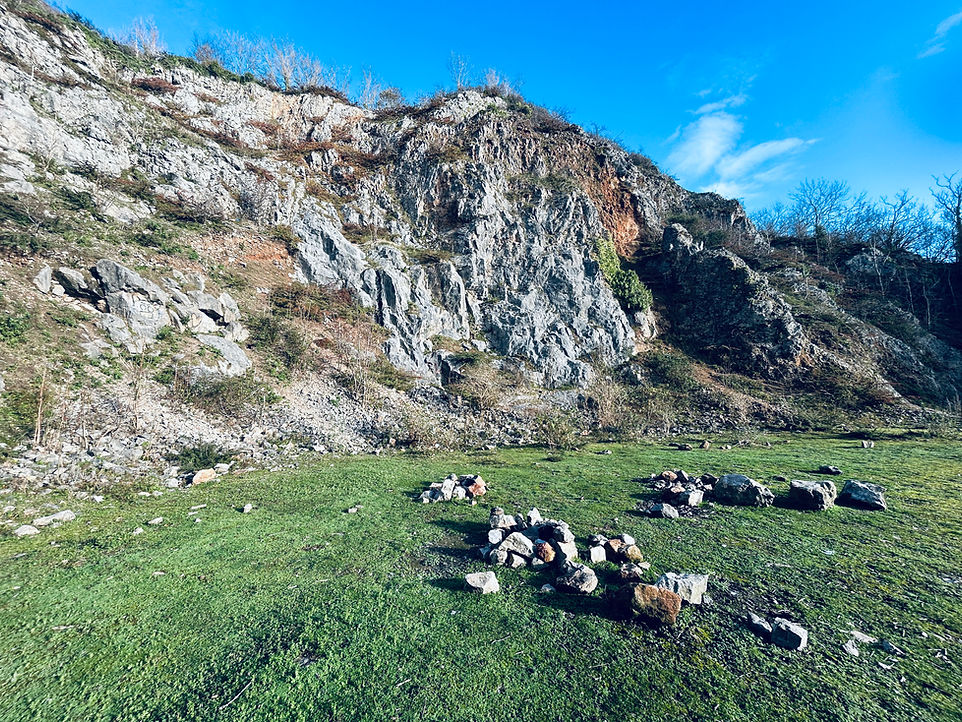
Known locally as the Ghost Canyon, nothing now remains of the once proud Dyserth Castle.
It was at this time that Henry ordered Dyserth Castle to be built, as recorded in various contemporary reports and chronicles. The site of the castle has been claimed to have had several names. In the entry for 1241, the Brut Y Tywysogyon calls the site, Castle of the Rock,(4) while its entry for 1263 names the castle, Carreg Faelan, a title repeated by Edward Lhuyd,
‘There has been a Castle at Tre Castelh, which some say was call’d Castelh Ffailon.’
Lhuyd, Parochailia, Vol.1, p.52
Curiously, it would appear that the initial foundations of a Dyserth Castle had been laid elsewhere - as the Patent Roll of September 3rd 1241 makes plain in a communique to John Lestrange,
‘It is well pleasing to the king that he fortify that place which he has provided as a gift near Rothelan; and therefore the king commands that giving up the first place which he began to fortify by his order, he cause the new place to be fortified.’
Patent Roll 1241, Membrane 4, Sept. 3rd, Chester, p.258
As you might expect, there have been any number of efforts to identify this original site of Dyserth Castle, despite there being no information as to the extent of these original workings.(5) It is entirely possible that very little of real substance was actually built before permission was sought and gained for an alternative site, or at least anything that would not have been thoroughly dismantled to provide materials for the new foundation. A cursory examination of a map of the Dyserth area will have you narrowing your eyes on nearby Graig Fawr and perhaps even Moel Hiraddug as possible sites, but despite some rather fanciful assertions, nothing has been found north or south of the castle that suggest a medieval foundation.
What has been found both on the site of what was Dyserth Castle before it was quarried to a bit of ashlar and rubble, and elsewhere, is evidence of much older prehistoric activity. The site was excavated in 1914 by T. A. Glenn, who discovered at various sites evidence of Neolithic artefacts, including flint, chert and felstone flakes, eight polished axes, an anvil stone, a bone necklace and some fragments of prehistoric pottery. He was also of the opinion that prior to the building of the medieval castle, Bronze Age peoples occupied the site, believing that he had found evidence of hut circles in the area which was subsequently used as the kitchen and its midden - to the north west of the castle proper. Dyserth was likely the settlement recorded as Dicolin in the Domesday Book of 1086, a derivation of Dincolyn - the Din prefix highly suggestive of the presence of a hillfort here.(6) There was also evidence of Romano-British activity, having found glassware, pottery, pins and needles of bronze and a hoard of Roman coins, which have since been lost. It seems certain then, that the Dyserth Castle of 1241 was built upon and within a site of ancient activity. The Neolithic evidence is particularly interesting, since it plays into what we already know of similar age, including at Prestatyn and Gwaenysgor, Rhyl and closer still, Rhuddlan - further proof that this area was a hive of Neolithic activity.

The Lidar image shows that only the outer courtyard is still discernible in the landscape.
There is essentially nothing left of the castle now. Already reduced to shattered ruins by the time of Glenn’s 1914 excavation, the rest was completely lost to quarrying by the end of the First World War. All that can be said to remain to this day are parts of the outer courtyard and its associated earthworks to the north east of the quarried out hill. Our only means of gaining an understanding as to the plan and layout of the medieval structure in its briefest of pomp is from the work of writers and historians, particularly those working at the end of the 19th century and in the pre-war years of the early 20th century - particularly, E. W. Cox, whose article of 1895 was the last to be written before extensive quarrying brought the remaining ruins to nothing.
Even though there is little to nothing of the castle remaining, the rock upon which it stood serves to impress upon us its once obvious strength.(7) The castle as it stood in its greatest strength was virtually impregnable on its southern and much of its western flanks, dramatically perched atop the crag, overlooking the route ways through the Vale of Clwyd and along the northern coast - not at all unlike the probable purpose - or at least one of them - of the Clwydian hillforts that preceded the Norman castle by many centuries. This southern and western strength was reflected in the marked absence here of significant masonry walling. Man-made strength in massive walls and towers were to be found, as you would expect, on its weaker flanks, to the north, where the rise to the castle is steep but not impossible, and the smoother, flatter eastern side, leading down to a plateau.
The outer courtyard remains - clear in the Lidar image. It was, and indeed is, a ditched and embanked, nearly square enclosure, likely palisaded, and containing those buildings you would expect - timber built storage, dormitories and the like. Movement from this outer courtyard into the castle proper would have been controlled by a gatehouse, and Cox was of the opinion that this would have been a significant masonry building. There is no reason to doubt the logic of his opinion, but as with much of what we think about the appearance of Dyserth Castle, we must acknowledge the complete lack of remaining physical evidence. There was undoubtedly a bridge, of course, crossing the ditch between the courtyard and the castle proper, but how this operated in practice is entirely unknown. Still, given the perceived weakness of the eastern flank, it seems likely that it was a drawbridge - speculation, of course.
By the time of Cox’s investigations at the end of the 19th century, much of what remained of the castle proper was much ruined, but enough remained for him to come to some sound conclusions. The main gateway to the castle from the east had been a mighty affair, flanked by two strong towers - the right semi-cylindrical and the left a curious, irregularly-sided polygon. Cox felt the gateway towers had been connected by some machicolation. The walls running south from the gateway to the north west of the castle were lighter affairs, acknowledging the almost impossible crag that defended the fortress from the south. A tower a little to the south east of the gateway and projecting a little towards the ditch facing the outer courtyard was thought by Cox to protect a well - a sound enough opinion given the importance of a water source to the ability of a castle to withstand siege.
The main buildings of the castle were, perhaps unsurprisingly, to the south. The Great Hall overlooked a southern courtyard, with a solar to its west, and an inner courtyard to its north. Following the southern wall overlooking the crag to the west, the wall seems to have terminated to the east in what Cox believed was a fortified redoubt, built to protect the gentler approach to the north of the castle and an open space behind it - a space believed by Cox to be a garden, but which actually seems to have been a courtyard of sorts and within which Glenn, excavating in 1914 found evidence, he believed, of Bronze Age habitation.
The northern face of the castle was defended by massive walls - between some five to eight feet in thickness, and included three towers, including the polygonal gateway tower. These towers were so placed to give excellent coverage of any approach from the north. To the west of the northern flank was what Cox believed was the Stable Tower - he believed he saw the workings for sockets used for the tethering of horses. This of course cannot now be confirmed, but what can be said is that it was a tremendously powerful fortification, facing and overlooking the redoubt to its west and creating a potential killing ground between them. Midway between the Stable and polygonal gateway towers was the so-called Constable’s Tower - a hugely powerful structure thrusting north and divided by the curtain wall that ran through it.

Cox's plan, reproduced here from the Journal of the Architectural, Archaeological and Historic Society for the County and City of Chester and North Wales, Chester (1895), cannot readily be confirmed - what with the castle now completely destroyed. However, the compass orientation is wrong - the outer courtyard (x-y) should, in fact be facing north east, not, as the diagram suggests, south east.
There is a sense with these early stone castles that they were lightning rods of Welsh ire - understandably so, of course.(8) The presence of these stone fortresses on Welsh soil were seen as an unacceptable affront to the princes of Gwynedd, and whenever possible, they responded accordingly. Contemporary sources, such as the Brut Y Tywysogyon and even English chroniclers such as Matthew Paris, paint a picture of an intense almost feral rage directed at these castles - Deganwy, Mold and Dyserth. Building in stone was not unknown to the Welsh - Dolbadarn Castle, built by Llyweyn ap Iorwerth, predates Dyserth Castle by at least a decade and likely more. It is not so much that stone castles themselves were alien to the native Welsh and thus the cause of such fury, but rather the meaning of their presence in Welsh territories - colonial outliers that sneered at native sovereignty. And it must be said, that this sense of intense rage that one can gain from reading early sources, is actually reflected at Dyserth in the archaeological record left to us by Cox and Glenn.
While Dafydd may have had little choice but to capitulate before the military might of Henry III in 1241, the political landscape had changed significantly by 1244. On St David’s Day 1244, Gruffydd, the half brother of Dafydd held by Henry III as a prisoner and counterweight to the Welsh prince’s ambitions, died in attempting an escape from the Tower of London. We are told by the chroniclers that Dafydd was enraged, and immediately entered into alliance against the English with those Welsh nobles so absent from his side in 1241. Given that Gruffydd’s death was in fact a boon to Dafydd, it is far more likely that rather than genuine anger at his half-brother’s death, the tragedy was seized upon as a means of unifying the Welsh to his rule and enabling an uprising against English rule in an attempt to regain his father’s lost lands.
Within weeks of Gruffydd’s death, Welsh forces under Dafydd and his allies were conducting hit-and-run raids against English strongholds and supply routes, with some considerable success. By the end of June 1244, John Lestrange was writing to Henry III informing the king that Dyserth Castle was almost entirely isolated from its base at Chester, some 25 miles away.
‘Moreover, you should know that the aforementioned David, son of Llewelyn, placed such great strength between Chester and your castle of Dissard.’(9)
John Lestrange, Letter to Henry III, June 1244, Shirley, p. 38-39
Strangely, however, Henry III seems to have not taken the Welsh rebellion as seriously as he ought - perhaps gulled into complacency with the ease of his victory of 1241. But serious it was, and the King’s response to Dafydd’s continued successes in the field was piecemeal and ineffective. If Dyserth Castle was not directly threatened in 1244, though isolated and adrift of its Chester tether, by the late spring of 1245 its capture had become an ambition of the Welsh. The rebellion had gained a critical momentum and urgency, the Welsh shrugging off a defeat at Montgomery in February 1245 to capture Mold Castle in March of that year - a stunning victory. And Dyserth Castle became the next target - the Welsh laying siege to the fortress soon after. This was the spur that moved Henry to action.
‘Mandate to the knights and free tenants of the county of Chester - the king having heard that D. son of Llewelin has given siege to the castle of Dissard - to be with their horses, arms and whole posse at Chester on Thursday the feast of St Margaret the Virgin to meet the earls and barons whom the king is sending there to rescue the said castle, and to be vigorous in the said recuse.’
Henry III, Calendar of Patent Rolls, p.456
Henry moved his forces from Chester in August 1245, reaching Deganwy on the 26th of the month, initially settling to refortify his castle there. What else Henry thought to achieve here at Deganwy is not clear. It is tempting to think that he thought a show of force would be sufficient to bring Dafydd to the negotiating table, and thus to a 1241 style capitulation. If so, he badly underestimated the resolve of the Welsh prince and his forces. For the next two months, Henry and his army found themselves harassed and bedeviled, pinned back on the east bank of the Afon Conwy and behind the walls of Deganwy Castle, while the Welsh conducted nightly raids upon English positions, ambushing supply lines, sweeping down from the hills behind Conwy whenever an opportunity for striking the increasingly beleaguered English forces presented itself. It was a battle of intense bitterness and brutality, with English forces carrying the decapitated heads of their enemies into the Castle as trophies, and the Welsh tearing apart the English dead and throwing the dismembered body parts into the Conwy.

An artists reproduction of the outer courtyard and the gateway which faced the north east, reflecting the weakness of the eastern approach - from Cox, Journal of the Architectural, Archaeological and Historic Society for the County and City of Chester and North Wales, Chester (1895)
What remains unclear is quite what was happening at Dyserth Castle as Henry III hunkered behind the walls of Deganwy. It has been speculated that the castle actually fell, but this is highly unlikely, given that there is no mention of this in any of the contemporary chronicles - Welsh or English. It is possible that the castle was gifted relief by the possible withdrawal of Welsh forces, in order to counter the English army moving along the northern coast. It is also possible that the garrison at Dyserth simply continued to hold out against the besieging forces. We simply cannot be certain.
With the approach of winter, and for a want of provisions, it is clear Henry had made a grudging peace with a withdrawal back along the coast to Chester. In the two months Henry had remained at Deganwy, the forces of the English and Welsh had beaten each other to their knees - one gets a sense from the chronicles of two unblinking, battered, broken boxers circling each other warily in the ring, bruised fists wearily held high, bloody and bone-tired. But it was the English that blinked first. Leaving a garrison at Deganwy,(10) Henry retreated.(11)

An artists reproduction of the northern approach to the castle again reflecting the gentler slope - from Cox, Journal of the Architectural, Archaeological and Historic Society for the County and City of Chester and North Wales, Chester (1895)
It is probable that Henry was of mind to renew hostilities against Dafydd in the following spring, but given the mauling his forces had suffered, it is an interesting thought experiment to wonder as to Henry’s plans for any further campaign. One imagines that the woeful complacency he had manifested through the back end of 1244 and beginning of 1245 had been swept away, given that war with the Welsh in 1245 had been a very different experience to that of 1241. As for the consequences of Henry’s retreat for Dyserth Castle, we are in the dark entirely. One would perhaps have expected Dafydd to move on Dyserth in the Fall of 1245, hoping to take the castle before the winter took a crippling grip. For all we know, he may have. It is more likely, however, that if any English castle was going to be ‘the true blank’(12) of his eye, it would have been Deganwy - an open sore that wouldn’t heal, and in any case it must have been a certainty that his forces were also in need of rest, reprovisioning and replenishment. Whatever the events concerning Dyserth, the castle remained in English hands through the Winter and into 1246, and the siege lifted.
It is difficult to ascertain the morale of the Welsh during that winter of 1245-46. On the face of things, Henry’s retreat had been a stunning victory, and there is no doubt that the Welsh had got the better of the conflict. But, though they had lost Mold Castle, the English still held Deganwy and Dyserth, and a trade blockade and the ravaging of Anglesey, the traditional breadbasket of Wales, made things extremely uncomfortable. But still, Henry’s ambitions had been blunted, and there was reason to believe that the Lion of Wales, Llwyelyn ap Iorwerth had sired no whelp, but a lion perhaps as fierce.
So, Dafydd’s inexplicable death in February 1246 was a hammer blow. How he died, or the causes are not known, but his death without legitimate issue immediately returned Gwynedd to a state of dynastic fracture, with Owain and Llywelyn, the eldest sons of Gruffydd and nephews of Dafydd dividing up the kingdom between them. Interestingly, while the war against the English continued, after a fashion, Henry himself declined a return in force. Would this have been the case if Dafydd had not died, is not known. It is possible that Henry was content with allowing Gwynedd to tear itself apart, thinking to play the brothers off against each other until he could ‘favour’ one of them to his own benefit and hold himself up as a sort of ‘father figure’. Such a role would have flattered his ego. But though Henry himself did not choose to return to the field in the spring and summer of 1246, his nobles certainly did. Nicholas de Moels (1195-1268/9), sensechal of Cardigan and Carmarthan and a man once senses the King could rely upon when something bloody was necessary, drove an army from north to south, casting aside all Welsh resistance as he marched through Meirionydd, Ardudwy and finally through the Conwy Valley, arriving finally at Deganwy. While he was unable to tackle the brothers Owain and Llywelyn directly, his route seems to have made plain the division between Gwynedd Is Conwy and Uwch Conwy - Above and Below the Conwy. A truce was called and held - eventually culminating in the humiliating Treaty of Woodstock in April 1247, in which the Owain and Llywelyn were confined to the west of the Conwy, losing the whole of the Perfeddwlad - the Middle Country, comprising Rhos and Tegeingl (Englefield) in the north and Rhufoniog and Dyffryn Clwyd in the south. Dyserth, along with the castles at Mold and Deganwy remained firmly in English hands.
What followed was a near decade of English overlordship. But in that time, Llywelyn ap Gruffudd established himself as the sole ruler of Gwynedd and began the process by which he was to rise to greatness and ruler of most of Wales. In 1256, the Perfeddwlad rose in revolt against the excesses of Geoffrey Langley, a English Royal official who had been put in charge of the Perfeddwlad and began to squeeze the territory for all the financial wealth it possessed. Henry’s son, the future Edward I, had been granted all the Royal possessions in Wales and visited his lands of North Wales in the summer of 1256, including, it is thought, Dyserth Castle.(13) It would seem the people of the Perfeddwlad had believed that Edward’s visit would lead to the reigning in Langley’s excesses, and when this did not happen,(14) the rising began in ernest, with Llewelyn called upon to support the revolt. At the beginning of November 1256, Llywelyn crossed the Conwy, and within a week had retaken all those lands lost to Gwynedd in that hateful year of 1247 - all except the castles of Deganwy and Dyserth which remained as English islands within a stormy Welsh ocean.
Llywelyn’s successes were nothing short of astonishing and continued through the winter and spring of 1257. In June 1257, Llywelyn achieved a crushing victory over the English at a place called Cymerau, probably near the confluence of the Towy and Cothi. Henry was stung to action, and mustered his forces at Chester. In August the king pushed into Wales once more and raised the siege of Dyserth Castle, in place since at least the November of the previous year, eventually settling at Deganwy, as he had near a decade earlier. If the surroundings of Deganwy were familiar to Henry, the result of his sojourn there would also have given him cause to ponder. By the onset of Winter, it was clear that Henry was not going to get the support from Ireland that he had requested, and so once again, decided to retreat to Chester, followed, we are told, by, ‘the derisive sneers of the enemy.’(15) One wonders as to the king’s thoughts as once again he limped from Deganwy along the well trodden coastal road to the Red City.
It would seem that a truce was arranged between Henry and Llywelyn over the winter months, which meant that Dyserth remained in English hands. But it was clear the King of England had every intention of resuming hostilities in 1258. However, the constitutional crisis in England that had been brewing since April 1258 reached a peak in the Provisions of Oxford in the June of that year, and reduced the fierce successes of Llywelyn in Wales near irrelevant to the English king. From thereon, Henry was no longer fighting for control of Wales, but for his very kingship of England. In the face of this crisis, the abbot of Aberconwy Abbey was able with some ease to arrange a thirteen month truce between Llywelyn, now styling himself ‘Prince of Wales’, and the English Crown. All Welsh conquests were recognised with the only concession to Henry being the right to resupply the English castles of Deganwy and Dyserth - a state of affairs which suggests that both were in somewhat difficult straits.
The years between 1258 and 1262 were largely ones of one arranged truce after another as Henry grappled with the growing threat of civil war in England. Llywelyn used those years to increase his holdings in Wales, bringing more and more Welsh nobles under his direct control, while also intermittently sparring with the English Marcher lords. But Dyserth Castle remained in English hands. Full conflict broke out once more between the Welsh and the Marcher lords at the end of 1262, with the English once again defeated at every turn. Henry III who had been occupied in France returned and immediately appealed for unity from his divided lords and called for a muster of forces at Ludlow in February 1263, with mixed results. It would seem that Dyserth Castle was once again under siege, since it is thought that Henry’s son, the future Edward I, pushed into North Wales from Shrewsbury and at least temporarily raised the siege of Dyserth Castle.
Edward’s relief of Dyserth lasted barely six months. In an alliance born of political expediency, Llywelyn joined with many of his former fierce Marcher enemies against Henry III during the spring and summer of 1263. It was with their implicit, if not openly explicit support and blessing that the Prince of Wales once more laid siege to Dyserth Castle on 1st July 1263, supported by Gruffydd ap Madog, Lord of Castell Dinas Bran and Powys Fadog. If previous efforts had ended in frustrating stalemates, with the English garrison determinedly holding on to the fortified crag against an equally determined Welsh foe, the summer of 1263 was to be very different. There was to be no relief this time from English armies out of Chester or Shrewsbury, no truce called - Dyserth Castle was entirely alone.
‘Llewelin, the son of Griffin, and Griffin son of Madoc besieged the castle of Disserth during five weeks, and having captured it the day before the feast of S. Oswald, king and martyr [August 4] they razed it to the ground.’
Annales Cestrienses, p. 84-85
It is likely that the five week siege had effectively reduced the castle to such a beleaguered state that a decision was made to storm the fortress on August 4th. In what state the remaining English forces were at this point is unknown, but it is hard not to imagine them in a desperate place. Quite what befell those that survived the siege and eventual storming is not known, but given the nature of the battles that had gone before and the near seven years in which Dyserth Castle had held firm against the Welsh, it is hard not to suppose that their fate was quick, brutal and entirely without mercy. Some have suggested that the razing of the castle is evidence of an unfettered rage on the part of Llywelyn and his allies, but I fancy not. The utter dismantling of Dyserth Castle was not a one-off, by any means. In fact, it would seem that in most cases in which English built castles were taken, the Welsh were apt to thoroughly destroy them - ridding themselves both of evidence of English rule and more pragmatically, a possible fortified position by which the English could re-establish themselves should they recover strength enough to return.(16)

Henry Gastineau's dramatic 1831 illustration of Dyserth Castle - Craig Fawr in the background.
The excavations undertaken at the end of the 19th and beginning of the 20th centuries seem to suggest that the Welsh came at the castle from the north west - evidence of possible mine workings were found here. This would make sense, given that defensively, it was here that the castle was at its weakest. Large quantities of burnt timber were found suggesting that the castle was on fire before its eventual storming. There was found evidence of metal gratings being wrenched from windows - possible evidence of the storming of the castle, although that cannot be confirmed, of course, not that there is nothing left of the fortress.(17)
Then there is the curious business of the lost Croes Einion - a supposed memorial to the son of Rhirid Flaidd, killed by an English arrow during the 1263 siege of the castle.
‘It was at a siege of this place that Eineon, the son of Ririd Flaidd was slain. A cross was erected on the spot, called Croes Eineon, the shaft of which ornamented with strange sculpture, now is supposed to form the stile into the churchyard of Diserth.’
Pennant, Vol. II, p.113
Thomas Pennant’s source for this tale seems to have been the 16th century bard and champion of the Welsh language, Gruffydd Hiraethog, who makes mention of Einion in his Pedigrees. A transcript of the passage is quoted by Elias Owen in his Old Stone Crosses of the Vale of Clwyd.
‘His (Ririd Flaidd’s) eldest son was Madoc, Enion the second and Howel the third…The said Enion was killed in a fight at Diserth in Flintshire, in memorie of whome a Crosse was erected there, and called Croes Enion, yt is, Enion’s Crosse, and thereon was engraven this distic.’
Gruffydd Hiraethog, Pedigrees, quoted in Old Stone Crosses, Elias Owen 1886, p.48
This ‘distic’ refers to an apparent inscription upon the cross, which was said to be as follows,
‘Oc si petatur lapis yste kausa notatur
Einion oxi Ririd Flaidd filius hoc memoratur’.
This inscription as copied by the 17th century antiquarian and collector, Robert Vaughan was barely legible, and its sense may have been much mauled over the centuries, even before Hiraethog’s copy of it. A translation of the inscription, or at least an understanding of its meaning might be considered thus,
‘If the meaning be asked of this inscription
Einion, the son of Ririd Flaidd, is here commemorated.’
Thomas Edwards, Archaeologia Cambrensis, 1912, p. 293
The cross was said to have been brought down from the hill in order to protect it from the elements, though quite how it then ended up, Pennant tells, as the stile into the churchyard is unclear. It had become confused with the far older cross, known prosaically as f2, and now within St Bridget’s, but this has been thoroughly discounted. Writing in the 1870’s, the historian A. O. Westwood described a third cross of which only a fragment remained in his time - that being used, as Pennant stated, as a stile into the churchyard, but he was able to produce an illustration of the stone as he saw it, while also reproducing an image of the cross as seen by Watkin Williams in 1759. It is a curious looking thing, depicting a nude figure standing on a circle enclosing a Maltese cross. Is it possible that this was Croes Einion? All trace of the cross has now, unfortunately, been lost.

Westwood's illustration of the mysterious now lost 3rd Dyserth cross - Croes Einion (no. 5&6)?
There is also the problem of dating - not just of the cross, but of Einion and his father. Rhirid Flaidd was a 12th century noble and a warrior of some fame - famous for one particular action in which he is said to have slaughtered an English foe and pursued the survivors as far as the swamplands of Tern by Shrewsbury. He is known to have had several children, one of whom was Einion. While Rhirid is known to have been active in around 1160, the problem then, of course, is that having his son at the siege of Dyserth in 1263 would comfortably have had Einion as a very old man - very old indeed.
As a result, the whole existence of Croes Einion and the tale itself has been dismissed as myth. Of course, this may be the case. There may never have been a cross, or son of the famous Rhirid Flaidd at the siege of Dyserth Castle. Or, we may have one of those curious affairs where the truth has become mired in time and subtly altered. Because we know there were other Rhirid’s, likely obscured by the fame and renown of the 12th century warrior, and other Rhirid’s with sons by the name of Einion. Was it possible that it was an Einion of a less famous Rhirid that fell at the siege of Dyserth Castle? Well, yes, frankly it is not beyond the realms of fantasy. Was it possible that there was a cross, perhaps a simple memorial stone on the hill above Dyserth? Of course, it was. Travel anywhere for any distance, and you will see improvised, makeshift, rough and ready memorials by the sides of roads and pathways, atop mountains and upon benches and trackway stone erratics - raised with love. Why should it have been any different in 1263? It is possible that the now lost third cross of Dyserth was in fact Croes Einion. I don’t think it serves any purpose to dismiss the tale out of hand.
It is also worth mentioning that Dyserth Castle has been linked to the nearby medieval residence of Siamber Wen. It is said that a constable of Dyserth Castle, a Sir Robert Pounderling lived at Siamber Wen, though this remains unlikely.

Built in 1241 and destroyed in 1263. Dyserth Castle existed for a mere 22 years - built under orders of an English king in order to wrest control of Wales from the Welsh, and razed by a Prince of Wales with no intention of allowing such a thing to be. Much of Dyserth Castle’s existence was spent with native Welsh forces surrounding it, its English defenders hanging on determinedly, desperately against an increasingly successful and motivated enemy. It fell in fire and was systematically torn down. It existed then for the next 650 years as an ever reducing ruin, until it was swept away by quarrying at the beginning of the 20th century. Its loss is a horrible shame, but it seems, in a curious way, somehow fitting that this castle has been all but erased from the landscape - one imagines Llywelyn ap Gruffudd would have approved.
Footnotes
1. Rex Angliae omnes Walenses sibi subjugavit castrumque fimavit in forti rupe juxta Disserth in Tegeygell.
2. ‘David, however, feared to encounter his [Henry’s] violence, both because the heat, which had continued intense for four months, had dried up all the lakes and marshy places of Wales, and because many of the Welsh nobles loved Griffin [Gruffydd] more than him.’ Paris, p. 372
3. Possibly on the site of what is now Gweneigron Farm (SJ 02460 75140).
4. Kastel y garrec yn ymyl y Disserth. nb. 105, 32-33, p.204
5. Thos Edwards, writing in 1912, claims to have had a ‘military friend’ examine ruins he believed were castle foundations, who then declared them unequivocally the remains of the original fortification - stating that masons marks and part of a tower had been found. However, no such remains can now be discovered, wherever he thought them to be - which is also unclear. p. 274
6. It is possible, of course, that the Din refers to Moel Hiraddug. But given Glenn’s findings, it would appear that the hill, Kastel y garrec, was in fact a Bronze Age hillfort before the medieval castle was built in 1241.
7. Most of what will be said as to the physical appearance of Dyserth Castle is based on the interpretation of E. W. Cox at the end of the 19th century. While I have no issue with accepting his conclusions, per se, it must be acknowledged that those conclusions are based on evidence we no longer have in order to assess those conclusions.
8. See also Mold Castle.
9. praeterea sciatis quod praedctus david filius lewleini posuit tantam fortitudinem inter cestriam et castrum vestrum dissard
10. ‘This castle of Gannock [Deganwy]... was, as it were, a thorn in the eye of the wretched, yea most wretched Welsh.’ Paris, p.115
11. ‘On the morrow of the feast of the apostles Simon and Jude, the king…made preparations to return to England, in order that he, as well as his army, might recover breath.’ Paris, p.114
12. King Lear, Act 1, Scene 1
13. profectus est in Wallia terras suas et castella videre
14. ‘...the Welsh…were at last so immeasurably and tyrannically oppressed by the king’s agent Geoffrey Langley, knight, that they roused themselves for the defence of their country and the observance of their laws.’ Paris, Vol. III, p. 200 - Giles.
15. Paris, Vol. III, p. 248 - Giles.
16. Mold Castle had been thoroughly destroyed in 1199 by Llywelyn ab Iorwerth, Deganwy was reduced to mortar later in 1263. In some instances, newly built castles or those in the process of being built were attacked and systematically dismantled - Cefnllys Castle in Radnorshire in 1262 is an example.
17. It remains a possibility that the mine, and in fact most of the other evidence of destruction, occurred after the fall of the castle in the process of dismantling the fortress.
Further Reading
ed. R. C. Christie, Annales Cestrienses or Chronicle of the Abbey of S. Werburgh at Chester, Manchester, (1886)
E. W. Cox, Diserth Castle, Journal of the Architectural, Archaeological and Historic Society for the County and City of Chester and North Wales, Chester, (1895)
T. Edwards, Dyserth Castle, Archaeologica Cambrensis 6th Series Vol. XII, (1912)
trans. Rev. J. A. Giles, Paris’s English History From 1235 to 1273 Vol. III, London, (1854)
J. E. Lloyd, A History of Wales From The Earliest Times To The Edwardian Conquest Vol. 2, London, (1911)
E. Owen, Old Stone Crosses of the Vale of Clwyd, Oswestry & Wrexham, (1886)
T. Pennant, Tours in Wales, Vol. II, (1781) ed. J. Rhys, Caernarvon, (1883)
ed. Rev. W. W. Shirley, Royal and other Historical Letters Illustrative of the Reign of Henry III, London, (1862)
ed. Rev. J. Williams ab Ithel, Annales Cambriae, London, (1860)